
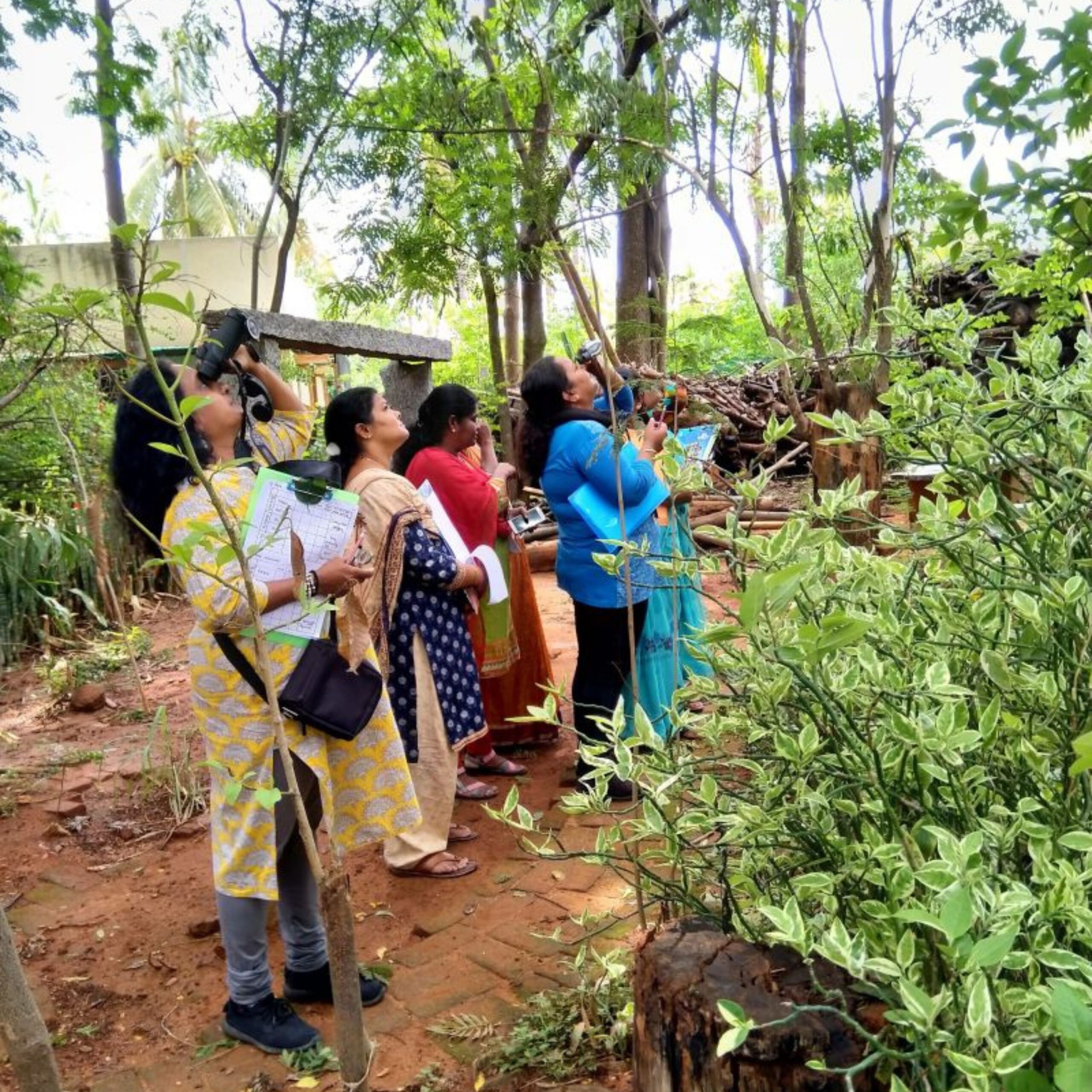
We speak with Vena Kapoor and Priyanka Prakash of Nature Classrooms, a nonprofit based in Bengaluru, India that helps educators integrate nature into their existing curricula. India is not just vast but also incredibly socially and ecologically diverse, and Vena and Priyanka talk about the importance of local and cultural relevance. Nature Classrooms also incorporates social-emotional learning into science professional development, exploring the social and emotional lenses through which teachers and students view nature.
Overview
00:00-00:49 Intros
00:49-05:47 Nature Classrooms
05:47-10:04 How Nature Classrooms defines nature
10:04-14:33 Social-emotional learning
14:33-19:45 Research: Differences between Global North and Global South
19:45-22:02 Environmental Studies Curriculum doesn’t make sense; alternatives
22:02-27:11 Integrating nature into the curriculum so it isn’t an extra burden for teachers
27:11-38:13 Culture, owls, and ethical dilemmas
38:13-43:53 Identifying situations as ethical dilemmas helps teachers think about them
productively
43:53-46:31 Building on religious and cultural connections and empathy for all animals
46:31-55:33 How and when to talk about climate change
55:33- Outro
Resources
Nature Bingos — Nature Classrooms
Activities that encourage children and adults to explore nature around their homes, schools, and neighborhoods through observation and sensory experiences. The collection includes Nature Bingo, Hidden Housemates, and seasonal activities.
Bringing Nature Back to Classrooms — Vena Kapoor, India Development Review, February 3, 2026
An article examining the limitations of environmental education in Indian schools and advocating for more locally relevant, experiential, and inquiry-based approaches. Kapoor discusses how teachers can incorporate nature into existing lessons without adding to their workload.
“Look, Don’t Touch” — David Sobel, Orion Magazine (2012)
An essay questioning approaches to environmental education that discourage children from touching and exploring nature. Nature Classrooms uses the reading in teacher workshops to introduce discussions of ethical dilemmas.
Research Projects — Nature Classrooms
Research on children’s relationships with nature, nature-based social-emotional learning for teachers and educators, and approaches to assessing nature education programs.
Transcript
[00:00:15] Amy H-L: I’m Amy Halpern-Laff.
[00:00:17] Jon M: I’m Jon Moscow. Welcome to Ethical Schools. Our guests today are Vena Kapoor and Priyanka Prakash of Nature Classrooms, a nonprofit based in Bengaluru, Karnataka, India. Ms. Kapoor is Lead and Senior Scientist, and Ms. Prakash is Senior Manager, responsible for curriculum development, research, and training. We’ll be talking about Nature Classrooms’s work, including the ethical dilemmas they help teachers to think about. Welcome, Vena and Priyanka.
[00:00:46] Vena K: Thank you, Jon and Amy. Thank you for having us.
[00:00:49] Amy H-L: Vena, tell us about Nature Classrooms.
[00:00:53] Vena K: Yes, so Nature Classroom started in 2018. We started it to get teachers and educators to notice nature around them, either in their school campus or outside their school campuses, and to try and make a difference in the school curriculum, because we were noticing that in the environmental sciences curriculum, which is a compulsory subject in India in the primary school years, the focus was very, what we thought was very human-centric approach to viewing nature and and thinking about nature. And so we really wanted to shift that perspective from what we were calling a human-centric approach to one which is more nature-centric.
And so Nature Classroom started with that in mind, and we wanted to collaborate with not just schools and the school community, but also education practitioners. And so this included education organizations that were mushrooming in India at that point of time and were working in different domains of education. And many of them weren’t sure how they could include a nature learning element as part of the education work that they were doing, and so that’s where we wanted to come in. The team has some background and experience and training in ecology, environmental sciences, and conservation, and all of us have a deep love for nature and a connection with nature.
The other main thing we wanted to try and do was to get a sense, or at least ignite or reignite a sense of wonder, curiosity, and love for nature. And we thought that should be the starting point for any conversation on nature, because it was worrying us that children and teachers were talking more about deforestation and climate change and less about just the wonder and awe of nature around them. And so we wanted the initial introduction to nature and the conversation and the content in the textbooks to be about just asking questions about immediate nature around them and to just stop and observe and just be fascinated and ask those questions that would get them to connect with nature. So we started designing teacher training workshops and training programs, like I said, to get teachers and educators first excited about nature. Also, to tell them that you don’t need to be a science teacher or a trained science teacher to teach nature or to connect with nature.
So we really wanted to break that thought process. And this we were doing by introducing nature to them through their language that they were familiar with. So introducing concepts in education theory and practice, and telling them how they can bring nature learning as part of their education interventions.
We also create what we call locally and culturally relevant nature learning activities and modules, and a curriculum that can either be weaved in as part of the school curriculum that the teachers anyway need to teach, or to tell them how they can do it outside the classrooms. And the interesting thing for us is that it had to be bespoke, whatever we were designing and trialing and testing, because most school spaces in India don’t have any outdoor spaces, especially the government-run schools. It’s often just one classroom, which is a small concrete box. Often it, it has nothing around it or it’s extremely concretized and completely built up.
So how do you get teachers to engage with nature in a scenario like that? And so we had to constantly juggle with that kind of a conundrum, and also had to think very creatively about how we could design what we were calling “nature learning interventions.”
We’re also interested in research because we felt like a lot of the research on nature education was coming from the Global North, and we didn’t have more grounded research coming out from the Global South, especially in India. And so we really were interested, and many of us come from a research background, so we’re interested in trying to contribute to the space, but also more importantly, to help inform the work that we do. So we do that.
And we’ve also more recently, in the last couple of years, been trying to create or develop or facilitate a communities of practice of nature educators who are in India, and there’s a mushrooming community of nature educators. So we try and facilitate conversations, collaborations, meetups, and things like that.
[00:05:47] Amy H-L: Vena, how are you defining nature? Are humans included in your definition of nature?
[00:05:54] Vena K: Yes, humans are very much included in our definition of nature. I’ll maybe give you one example to clarify what I meant by moving from a very human-centric approach to a nature-centric approach. In one of the class grade two textbooks in the Karnataka state syllabus, which is the state we are in, there’s a chapter on trees, and there is this illustration of a tree, and there are smaller illustrations surrounding the tree which talk about what do trees give us, and that’s the heading of the chapter as well. And so it talks about how trees give us wood, trees give us food, trees give us shelter. And so what we mean by bringing in nature, moving from a human-centric to a nature-centric perspective, is to say, “Okay, trees give us all this, and we retain that narrative, but we wanna push the narrative for the teacher and for the students to get them to think about what trees also give other creatures, or how they are an important ecosystem for other creatures as well, like birds, animals, insects, et cetera.
And depending on the age group that we want to demonstrate this to, the tools we design to demonstrate this differs, right. So for a grade two class, we came up with a very visual kind of a design, talking about how trees are also shelters for bats or birds, or how birds use material from plants in order to build their nests, right. So we bring in that little bit of an ecology component to it as well.
Same with cleanliness. There is a chapter on cleanliness in one of the textbooks. Now, I must add here that when they say EVS as a subject in India, which expands to environmental sciences, it’s a compulsory subject from the first grade to the fifth grade. They also add in a lot of social science elements to it. So it’s the modern version of moral science, if you will. So there’s also a chapter on cleanliness, for example, and telling the students how they should keep themselves clean by brushing their teeth with a toothbrush or making sure they have a shower or a bath, using soap, how they should keep their hands clean, et cetera. And that’s all there is in the chapter. And so what we wanted to do to bring in a nature learning element is to say, “How do animals keep themselves clean?” How do birds have a dust bath, for example, and why do they do that? And so this could be in visuals or in short video clips. And for us, the heartwarming experience for us, when we do this, is when we see the teachers almost going, “Aha,” when we demonstrate this is what we mean by moving from a human-centric to a nature-centric perspective, and to tell them that it’s not so difficult.
We’re not adding to their teaching burden, because teachers here, I think like in many parts of the world, are really stretched. They have to finish their syllabus in time. They have to finish their curriculum. So they don’t have too much leeway to add things to the curriculum or syllabus or to be more creative. We’re hoping that through these small little interventions, there’s a little shift in perspective.
The other thing we try to do is to take teachers on a short nature walk just around their school campus or within their school campus to tell them that really nature’s all around us. It can be that small little sapling that’s peeking out of a concrete wall.
It could be a two-tailed spider that’s cleverly camouflaged on a small tree which is in their campus. It could be that little fruit which they’ve only seen, but they don’t know which bird consumes it and how it actually came over there. So those small little interventions we feel are a good starting point for us because we feel that unless teachers and educators are excited about nature and feel connected to nature themselves, or just see the excitement of being part of nature, they wouldn’t want to take that to their classrooms or even try and make those little changes in their teaching-learning practices.
[00:10:04] Jon M: I have a follow-up question about research which I want to ask, but before I do that, I wanted to bring Priyanka into the conversation, both if there was anything that you wanted to add to what Vena has been saying, but also you have a background in social-emotional learning, and if you could tell us some about how this fits into your work.
[00:10:25] Priyanka P: Thank you, Jon, and thank you, Amy. I think Vena fairly covered what the foundation of our work is. The idea behind the social-emotional work that we have been trying to do for the past few years is that we recognize that in India, as Vena mentioned, the teachers and educators are extremely overburdened and stretched, and are expected to meet the curriculum requirements that the board prescribes to them. And often, when we take these nature learning interventions to them, we see that they feel that it’s an addition that they need to take up, which may just stress them even more, or they don’t have the bandwidth for something like that.
And so how we first started seeing social-emotional learning as an integration into nature education was to understand if we can design interventions that take into account how a teacher and an educator’s social-emotional state supports them in the way they think about nature and engage with nature itself.
But over time, I think that expanded, the definition itself expanded for us, where we started looking at it in a way of what learning environments do we want to create when we think about nature education itself? Given how socially and ecologically diverse India is, our curriculum and our syllabus does not take into account that diversity, right. So we have class-based diversity, caste-based diversity, gender-based diversity. We have diversity in terms of what even people culturally engage with. But often our environmental literacy content focuses much on the science of things, much on how to solve a problem that’s around us. how can we bring in what is already present in the systems that people are a part of?
And at the same time, looking at the part Vena talked about, how we can ensure it’s keeping in mind the emotional well-being of the people who are engaging in our intervention, right. So oftentimes environmental programs talk about deforestation, climate change, how the world is ending, and there’s an urgency to solve all these crisis that surround us.
And in my research, what I’ve come across is that often that doesn’t help in actually pushing people to action. It can quite quickly push people towards numbness or not wanting to do anything about it. And so how can we design interventions that don’t just look at the literacy levels of how much you understand environment around you, but how are you actually thinking about it, through a social lens or through an emotional lens? Allowing students and teachers to talk about fears in nature, right. It’s very, very real, and it’s a survival thing in humans to be scared of the nature around us, right, and so our schools and learning spaces allow for that conversations where we are talking about things that make us scared, make us feel fear, make us anxious.
There are enough studies now around eco-anxiety, eco-grief. You have things that talk about how nature deficiency can lead to long-term implications in students. But unfortunately, especially in the Indian context, because the student to teacher ratio is so high, so you have one teacher who may be catering to up to 50 students in a classroom, how do you expect that teacher to actually bring in these conversations, understand what different students’ experiences with nature are.
And in many rural parts, or even urban cities, nowadays in India, the reality of climate change is like right in our backyard, right. We are directly experiencing it. But the kids are seeing definitions in the textbook that maybe do not account for the fact that they are actually experiencing it in their backyards, right.
So they’re learning about droughts, they’re learning about heavy rains, they’re learning about floods, which only remain as definitions and don’t go a step beyond to understand how kids are actually, and even teachers, for that matter, are actually experiencing it in reality. So what we try to do is when we do our workshops, we bring in that element for teachers to think about. What are some of the reflective circles you can create in your classrooms that allow for students to discuss these things as well, which push beyond just merely being definitions and things that they have to write in their exam papers to get marks, right. So where can we bring that social-emotional lens into nature education? Make it, in that sense, inclusive, safe, and also space for kids to say what the reality for them feels like. I think that’s been the core of our work with respect to nature-based social-emotional learning.
[00:14:33] Jon M: Wow. So my question, going back to something that Vena said, but I think, Priyanka, that some of the things you said also address this. You mentioned, Vena, that a lot of the research is from the Global North rather than from the Global South, which seems like a really important point. Since most of our audience is in the Global North, and particularly mostly in the United States, could you talk a little bit about what some of the things you’re thinking about are and what some of the implications of this are?
[00:15:02] Vena K: So one of the early projects that we tried to do was to understand, for example, how do children in rural areas, what is their relationship with nature around them, right. And we did this in collaboration with the Azim Premji University in Bangalore. And the idea was that because Nature Classrooms was working with the primary sections, first to fifth grade, which have environmental sciences as a compulsory subject, we wanted to understand what students who went through this kind of education, when they were in the sixth, seventh, and eighth grade, has their relationship with nature changed at all based on what they’re learning in school or not? What is their perception of nature around them? What is their connection to nature around them? Those were some of the things we were trying to understand, and we realized that some of the tools and indices that were being used, that were used when we went through research papers that were coming from the US and the UK, we found that some of these indices didn’t really make sense in the context of India.
So it was very important to read those papers and to understand how some of these research questions were approached, but we have to tweak it and redesign it for our context as well. And so you’ll see some of that and I can share the reports with you so that you can link it to this podcast as well, if that’ll be useful.
And so some of the interesting insights we got were, of course, that even in a city like Bangalore, there is an urban-rural divide, right. So because it’s a city that’s growing, we have a lot of migrant population who are settled in the city and who have come into the city just a few years back because of the construction boom in Bangalore. The children of these construction laborers are in government schools, and so many of them don’t see Bangalore or the nature in Bangalore in the city as nature at all. In fact, they consider it, say, dirty or not safe. But they would say that nature back in their villages is what they would consider safe and nature.
Some of these very interesting insights we were getting just by having conversations. We had little interviews with students of that age group. We also used tools like drawing and illustrations to understand what they were observing when they were, say, walking from school to home and back. And so what, were they typically only drawing very built-up areas or were they also noticing the trees or the shrubs around, you know,under them?
Or if they were a typical student from a richer school who would typically live in gated communities or high-rise buildings, their perception of nature was completely different. It was their pet dog at home that they considered as nature.
There was a small forest patch that some of the students who we were interviewing, my colleague actually who was working with us at that point, it was his research project, he was doing that work. When he spoke to them, the students spoke about how it was a space. It looks like a lovely forest, but her parents would not allow her to go there because it was seen as a space of danger. So she wanted to engage with nature, but she couldn’t because maybe her parents thought it was not safe. It was where strangers were hanging out, for example. So even the small urban patches which should have been spaces where children should actually engage with nature were unavailable to her.
There was a student who said how when she feels sad, she would go and talk to a tree at her school. But when she said this, she said, “Please don’t tell anyone I told you this, or at least don’t tell anyone that I told you this because I don’t want people to know that because I’m embarrassed about it.” And we felt very sad when we heard this because really we should normalize a child talking to a tree, for example. It shouldn’t be some- something to be ashamed of. So some of this we felt was we needed a little bit more understanding from the perspective of the Global South to actually design research projects that’ll make sense for our context.
And it’s the same with Priyanka’s social-emotional learning research work that she did as well. A lot of the literature that she was referring to was from the Global North, and so she had to tweak it to make it more relevant for a context like India.
[00:19:45] Jon M: What did you find when you asked the students in, like, sixth and seventh grades whether their relationship or their concepts of nature had changed or not as a result of what had happened in school?
[00:19:58] Vena K: None of them, none of them mentioned the school. None of them. None of them mentioned studying it in school.
[00:20:02] Jon M: Wow.
[00:20:03] Vena K: Many of the students from the high-end schools often, for them, nature was in the countries that they were visiting on their summer holidays if they could go abroad. So it’s in Singapore, or it’s in Australia, or it’s in South America. So these are the kids who are well off, who can afford to go for holidays to another country.
Or they would go to a forest in India, but again, I don’t want to call it a superficial understanding of nature or connection to nature, but typically it’s the big mammals, right. “I saw a tiger.” That was their relationship and understanding of nature. So this really reinforced to us that, and we wanted to show that this is why the content in the EVS textbooks doesn’t make sense.
We really need to start from a space where we allow teachers and children to just explore around them, even if it’s a small plant in their backyard. How do they actually engage with that plant? We want to tell teachers that nature’s in their backyards. They don’t have to go to an urban park, which is an hour away from their school, in order to teach nature or to get children to engage with nature. Or they don’t have to go to a forest that is a two-day trip or an overnight trip from somewhere. Because usually it’s the logistical difficulties that teachers tell us, that they cannot do that. They want to show their students nature, but they cannot. And so with our little nature walks around, we show them that that’s possible. So we’ve created little, what we call nature bingos, and I can show them to you. It’s just a very simple A4 size sheet which gets students and teachers to go around looking for things, and you just play it like a bingo game. So do you see a small little plant peeking out of a wall, for example? And then there are little follow-up questions that you can engage with as part of that activity.
[00:22:02] Amy H-L: Well, we’ll certainly link that with the podcast. Priyanka, how do you help teachers to integrate nature into their existing lessons so they don’t feel that it’s just an extra burden?
[00:22:17] Priyanka P: Yeah. Yeah, I think that’s such a great question. It’s something that since, I think, Nature Classrooms started, we’ve been trying to find different ways of, I don’t know if this is the right word to use, but of selling the idea that you don’t need to shift away too much from your lessons that you have in mind to bring in nature. And one of the key ways I think that we, and we recently engaged in a project where we could work with a chain of schools to know what their curriculum is and bring in a nature integration into it. And one of the methods in which we do it is we basically first try and engage with the teachers to understand what is it that they’re already teaching in their classrooms, right. So, what are the systems that they follow in terms of planning their lessons, the tools that they use? And what we try to do is we try to bring in one element of nature into it. So, if I can give you an example, EVS, as Vena was saying, in India, is not just environment science, it also includes science and social science. So there are chapters in EVS that look at states of matter: solid, liquid, gas. You have chapters on electricity, earth and space, et cetera. We actually spend a lot of time internally brainstorming that if a teacher has to teach a lesson on electricity, what it is that they can do to bring a nature element to it.
And some of the simple ways in which we try to do it is to introduce natural history stories of how animals in nature probably use electrical signals. And so not just thinking of how humans generate electricity, but actually bringing stories from nature that a teacher can just integrate through a five-minute story narration in their classroom, right.
The other ways of also doing it are, for example, we use examples from nature to teach core concepts. So lessons like sound, for example, where teachers have to teach pitch, frequency, and amplitude. We actually get in things like bird calls and bird songs, telling teachers that you use them as examples to teach exactly a concept you’re anyway going to teach in your classroom. So just getting teachers to not feel like they need to entirely teach a whole new chapter or a whole new concept.
But, like, I think, Amy, the question that you asked, are humans seen as a part of nature or separate from it? The idea is to emphasize that you can teach almost anything using examples from nature.
And one of the things that we frequently hear from teachers is that they don’t have access to that information, or they don’t know if the information that they’re trying to bring in is accurate. So what we also then try to do is to provide these short information pieces for them, like natural history stories or put together two-pagers that they can easily use in their classrooms to guide the lessons that they want to teach, ensuring that it links to what they already have to do.
And so far, that’s been working a little well for us. Teachers have shown interest. The other, main thing that we try to do is, because India is so biodiverse and has such local diversity that exists, biodiversity that exists, we try to bring that to the teachers that, hey, you don’t need to talk about Antarctica and polar bears and distant snows. You can talk about the Himalayas in our backyard. Talk about the snow leopards. Talk about bears that exist in the landscape that’s around us. You don’t need to always talk about birds of paradise. You can talk about the birds that exist in our country as well. And so bringing those local examples, also bringing that fascination that, hey, I didn’t know this is there in our country, which a lot of teachers, it surprises us, but they don’t seem to know.
Also, access to documentaries, access to videos is a lot more from other parts of the world, and we feel it’s only now building more in India, so you have a lot more documentaries now coming in India that talk about local biodiversity.
Usually, the journey we push teachers to take the students through is local to global. Start with local examples, talk about things in your backyard, then you can talk about things that are in, for example, Asia. Then you can move to things that are across the world, where kids are able to make that correlation. So broadly, that’s been our approach, where we try to understand what teachers are already doing and see what are the easiest methods in which they can just introduce nature. Even if it’s just a five-minute conversation, can they bring that into their classrooms in a way that’s comfortable for them and in the way where they feel confident to take it to their students. Vena, if you would like to add to this..
[00:26:15] Vena K: If I can add just a small point. Thanks, Priyanka. So the other thing we try to do when we want teachers to get hooked is to also bring in the element of culture. So for example, if owls are seen as good luck in a particular culture, in a particular state, we try to bring that in because people relate to nature through cultural connections very often, through festivals, through food, through superstition, for example. What do they consider as good luck or not? So we try and bring that element in so that there’s also an element of pride and familiarity, right? Because they understand a particular thing, because either they’ve grown up with it or they’ve only engaged with that element of nature because their parents have told them or their grandparents have told them something, or they’re in a community where that’s a very important element to engage with.
[00:27:11] Amy H-L: So, Vena, how would you bring an owl into the conversation?
[00:27:17] Vena K: I’ll give you an example of why I said this owl, you know. Because the first teacher in nature immersion workshops that we did. We like to call them nature immersion workshops for teachers and educators. It was with a school called Parikrma in Bangalore, and these teachers were really excited, wonderful teachers to work with. And we took them to a small green patch on the outskirts of Bangalore because we wanted them to get out of their school campus because we realized that when they’re in their school, even though we wanted to engage with them in their workspaces, they were constantly distracted by phone calls, students coming and asking for their attention, or other teachers talking to them.
So we said, “Okay, can you give us half a day and let’s get out of the school?” We didn’t go very far from Bangalore, just a little bit, half an hour from Bangalore. It’s a lovely space. And we knew that there is, because we’ve been to that space many times, there’s one tree that houses a small family of spotted owlets. They are small owls. They’re the small owl species. They’re called spotted owlets. Very, very cute. And this was the first time the teachers were going to use binoculars. So we got binoculars for them. We also got hand lenses, and they were just so excited to be seeing. And we were lucky that we saw lots of insects and spiders that day as well.
And then we took them to this place because we knew these owlets are there, and they’re extremely curious, this particular family of owlets. They’re used to humans, I think, and so they come out even in the daytime. And we asked the teachers to use the binoculars. Many of them didn’t know how to use them, so we had to start from there. And then we asked them to look at these birds. We didn’t tell them they’re owls. And they looked at them, and they were like, it ranged from “Wow” to “Oh my God, it’s so cute,” to some teachers gasping and actually, like, reeling back So some of the teachers who were excited and were saying, “Wow,” and wanting the other teachers to look at it through binoculars were wondering why some of these teachers were walking back and didn’t want to engage.
And we were just quietly observing this whole scenario. And some of these teachers said, “Oh, owls. Look at these owls. They’re so cute.” So they said, “No, no, it’s considered bad luck, so we don’t wanna see them.” Because it’s been drilled into them that if you see an owl, something bad will happen to you or your family. In some parts of India, in some states of India, owls, looking at owls or spotting an owl, especially in the daytime, is considered bad luck. So these two teachers who expressed this were from one particular state in India. The other teachers seemed to either not be bothered about this particular superstition, or they were from a state where this was not considered a bad omen. And so they started engaging with their colleagues, saying, “No, but you, don’t you know it’s a superstition? You don’t know what you’re missing. They’re not those big owls which look evil. They are these really small owls. Take a look. Take a look. It’s amazing to see them through the binoculars.” So we saw this whole thing playing out, and we wanted to intervene, but we could see that this conversation was becoming a really nice teaching-learning experience even for us. And so finally, one of the teachers actually got curious, and the same teacher who said, “No, no, I don’t want to look at it because it’s bad luck,” she actually took the binoculars and looked at it, and she said, “Oh my God, they’re so cute.” And we just ended it with that. We said, “Okay, let’s…” Some of it was getting a little heated because some teachers were saying, “Oh, I can’t believe that you believe in these superstitions. What’s wrong with you?” And so we didn’t, we really didn’t want to want the conversation to get too heated, so we left it. But for us, it was a very interesting conundrum of sorts, right. Because we go in with this assumption that everybody should love a spotted owl. Look at them, they’re so cute. Or should love a…
Like, I love snakes and spiders. I love to look at them for hours. But somebody else might have a real innate fear for them, whether it’s passed on from their family members or it’s just an innate fear which they’re not able to understand. And so how do you take that into account? How can you be sensitive about that, but also open up the conversation for others to discuss these and create that space for discussion and debate and for people to be okay to not engage with something if they’re not comfortable with it?
[00:31:58] Jon M: When we talked before, you had mentioned this example of the owls as an example of one of the ethical dilemmas that you sometimes come across, and that is a wonderful example. Could you give us a couple of other examples of dilemmas that you encounter with teachers or students and how, in general, you talk about them and try to deal with them?
[00:32:21] Vena K: Yeah. So like I said, we think the starting point to engage or to connect with nature should be about curiosity. And a lot of that curiosity comes from touching and feeling and smelling and experiencing, right. And we feel that’s a very important thing to do. For example, just touching the bark of a tree. And for a child, the curiosity comes from that, the touch and feel and maybe the pulling apart and understanding how does this flower function, for example. And a lot of people said that was a very important and crucial experience for them to go through to connect with nature, by climbing a tree or maybe squishing an ant and then looking at it through a hand lens.
But of course, as nature educators, there is this. We feel that things should not be destroyed. You’re looking at something, you want to engage with it, but you really don’t want to, quote unquote, “destroy something,” right? And like Priyanka said, very often classroom sizes in India are 40, 50, 60 children and one teacher. Now, if all children have to engage with nature by touching and feeling and smelling, you might have a small little mini-destruction of things around you, right, if that happens. And so when we do our teacher training workshops, we put out these short little scenarios or case studies. And this has happened with us, and I’ll give you an example of maybe a scenario and case study.
We say that the scenario usually starts with you are a teacher and you’re taking a group of 40 students out for a nature walk, and you see a lovely beautiful butterfly that’s settled on a flower, and you point it out excitedly to your students, and all of them are saying, “Wow, look at the colors. Wow, that’s so beautiful.” So the scenario is that the students are looking at it and saying wow and ooh and aah. But one student picks up a stone and throws it at the butterfly And so our question to the teacher in the teacher training program is, how would you as a teacher react to this? What would you do in a scenario like this? Is this an ethical dilemma or a moral conundrum for you as a teacher? Because before we introduce this segment, we talk about how nature should be experienced and felt and touched, for example, right.
And we also give them a paper to read by David Sobel, a very, very nice article which is titled “Look, Don’t Touch,” and he talks about how nature educators and teachers are constantly telling students, “Don’t touch. Look at it, but don’t touch it.” And he says, “How will students understand the beauty or experience the beauty of a flower if they don’t touch it?,” right. And so he gives really nice examples about this. So we’ve asked the teachers to read this little article, and then we pose this moral dilemma a question to them. And then as part of these discussions, we try and tell them that there’s no right answer to this, but the important thing is to go through that process of reflection, process of thinking, process of debate, a process of even talking with your peers and your community about how should we deal with a situation like this, for example.
The other scenario we put across is that we have a citizen science program called Season Watch that our colleagues run, and this is to get students to monitor a tree and see how it’s responding to the changing seasons. So when is it fruiting? When is it flowering? Are the leaves dry? Are they fresh? And to make them citizen scientists, right. And this is one way to get students to connect with nature. So many of these students adopt a tree, and every week they look at it and monitor what’s happening. And these students have come up with such interesting data that they’ve collected over the years, and they themselves are able to correlate how with the warming climate trees are responding in different ways.
And so our scenario to these teachers was that your student, who’s been monitoring a tree for the last two years, suddenly comes to the tree and finds, when she comes to monitor the tree, she finds that two large branches have been cut by the electricity department because there’s an electricity pole that’s coming up there And your student is very sad, and she’s crying. And she says, “Why have these people cut the branches of the tree?” How would you as a teacher respond to this? Now, there’s a very nice social-emotional learning element to this scenario as well, right. But through the process of this conversation and this discussion when we are presenting the scenario, many teachers from areas that, for example, don’t have 24 hours electricity say “that electric pole is very important for us. It had to come up there. And so that’s what I would tell my students.” But teachers from cities that have no problem with 24-hour electricity supply say that, “Oh, I would tell my student to write a letter to the local minister or the local governance and say, and to protest or we’ll, let’s, let’s make posters to say, ‘Why did you cut my tree?'” And it’s, so it’s very important for the teachers themselves to realize that they each would respond very, very differently based on their socioeconomic condition, their own experiences, et cetera, growing up. So we keep reinforcing the teacher that it’s not a, there’s no right or wrong answer to this. But every teacher and educator will respond differently based on their scenarios, based on their experiences.
[00:38:13] Amy H-L: Priyanka, do you find identifying these situations as ethical dilemmas helps teachers to think about them productively?
[00:38:22] Priyanka P: Yeah, I definitely do because oftentimes when we ask teachers these questions, they reflect back that they have already engaged with a situation like this, right, like for instance, a child throwing a stone at something or plucking something. Teachers often tell us their immediate reaction is to either shout out at the child saying, “Don’t do this,” or in some cases tugging the child away from the situation. But not really seeing it as something that can actually become a learning moment for a child. And so we often see teachers after this discussion come up, “Oh, I didn’t think of it this way,” or, “I didn’t think this could be addressed in a different way,” or that, “This could be something that could leave a child with a long-term impact of based on how I react to them.” So I definitely think that it also brings up more conversations of some of the ethical dilemmas they’ve probably already experienced.
It also brings out some of the social diversity that I feel sometimes as facilitators ourselves, we forget about, right. I have done workshops with teachers where teachers have come up and told me that they feel like throwing a stone at an animal that they’re seeing. And for me, in that moment, I am like, here we are trying to tell teachers how to take this to students, but you also see teachers sometimes having those reactions that again, may be something that they have done in their childhood. A lot of teachers will share with us how they have pulled apart or stringed insects like dragonflies as a kid or dug out ant lions and, you know, played with it or smashed some insect. And I feel these conversations allow the teachers also to reflect that while we understand why this is happening, it’s important to think about how we address these situations.
And often teachers don’t have that time or space to do it. They feel like it’s a rush. They need to take kids for a field visit or take kids outdoors. They need to quickly finish whatever they had planned and move on with it. So I think this moment of reflection is what we hope for when we do these ethical dilemma segments with them.
It’s also often interesting to see teachers talk to each other and say, “Hey, no, maybe that’s not the right way. Maybe we should do it this way.” So definitely I think it’s a crucial element in our workshops, and we try as much as possible to ensure we give it time whenever we do it.
Priyanka, do you want to give that Bahraich example? I was thinking that that might be a good fit over here. The conflict with the wolves as well, no?
Yeah. So one of the regions in which we had done a teacher training workshop last year is a region where , as in many parts of India, there’s active human-wildlife conflict that takes place. And the region that I had been to had recently, in fact a month back before I went, had a massive conflict with wolves over there, where there was a report of wolves having attacked humans, and there was an active fear presence. So even when teachers, when we were talking to them about wolves, you could sense that fear and that sort of anger towards wolves. And, in a sense, you were a little worried about how we would bring up such a conversation with them. But as a part of one of my social-emotional learning activities that I do with teachers, I try and ask them to map out their socio-ecological identity towards their landscape. And I do this specifically when teachers belong to the same region. So in that moment, the region that these teachers belong to borders Nepal, so it’s a exact region between India and Nepal. So they see biodiversity that’s also connected to the Himalayas, but they also have the grasslands that are a part of the state they are in, and wolves being a conflict situation. So prior to me doing that activity, I remember teachers were actively voicing how they are not okay with the wolves attacking children. And a lot of that “information” was misinformation that was being passed around. So a lot of it you could see was secondhand fear or secondhand glorified information of stories of how wolves are attacking. And you could see that it was not coming from a place of understanding what was actually happening, but rather just wanting to, what we say, WhatsApp message, that’s passed on, that a misinformation that’s being sent out.
So we asked teachers to do this socio-ecological identity activity where we asked them to basically map out the entire natural features of their landscape. So it could be the mountains, the rivers, the lakes, and also the biodiversity that represents their landscape. And we asked them to link their social connection to that space, the cultural connection to their space, and the emotional connection. And a lot of the teachers talked about how as children growing up themselves, wolves are a very prevalent species in their landscape. And it’s not the first time that there’s wolf interaction in that region, right. And so then they started bringing up folk stories about wolves, how growing up they’ve heard about wolves, what wolves mean to them in their culture. And not just wolves. They started talking about the rivers that flood over there, what that means to them, how that has changed over time. And it was really nice to see that what started off with- Which I very well in the beginning my immediate reaction was to sit down and tell them, “Hey, what we are saying is not right information. You need to read up and get a better understanding of what’s actually happened,” ended up with actually teacher saying that, “You know what? I think we need to understand that humans have also taken up more space in this region, and animals don’t have enough space like they used to when we were children. And so we little bit understand why wolves are maybe wolves attack the way they did.” And then we could take the conversation forward by saying that, “Oh, have you read what the actual reports are? What has actually happened?” So I feel like sometimes giving time for teachers to also connect with their own memories and their own experiences with a lot of what the nature around them is also brings a room for talking about these ethical questions. And it worked really well in that situation because human wildlife conflict had just occurred, so we could actually talk about something that had recently happened to them. So yeah.
[00:43:55] Amy H-L: So you’ve mentioned that there’s still deep religious and cultural connections and empathy for all animals, all living beings, although these seem to be lessening. Are you able to build on these still?
[00:44:11] Priyanka P: We do. A lot of our time in workshops before we even begin talking to teachers about our pedagogical approach and, and bringing in the larger ecology itself, goes into understanding how teachers already connect with a certain landscape. In many regions across India, even today, religion is a big aspect. Especially if you go to forested areas, things like sacred groves, areas within deep forests that people actually go and worship, are a key part of how people connect with nature. A lot of the stories that teachers bring out, and this is something that we try to do, they bring out stories from religious beliefs of how nature has been perceived in mythologies, nature has been perceived in folk stories, in their ancestral songs and music, and the way they, say, worship a certain deity, right.
So we often see that that’s a strong point of connection for a lot of the teachers. Also because in India, religious diversity is pretty high. You have very localized communities who have their own specific ways of worshiping. At the same time, you have the bigger religions also that take place, right? So while we don’t actively talk about it in the sense of like, “Oh, what is the connection between religion and nature?” we do use it as a way to understand how teachers are perceiving nature, and oftentimes it includes teachers singing songs in our sessions about how they have learnt about nature growing up. A lot of the teachers would tell us how sacred trees in their temples that they pray are such a crucial part of their way of connecting with nature. A lot of the species of birds and insects also have religious connotations, which often teachers bring up. So our goal during workshops is to allow room for those conversations, because I think that’s such a great way to allow people to express their connection instead of us telling them, “Hey, this is how you should be connecting with nature.”
And so I feel the social, culture, and religious diversity in India allows for everyone to have a unique relationship with nature. And so we use that as a starting point, and then we bring in the entire ecological lens, the scientific lens, the social science lens. So really trying and making it interdisciplinary, but reminding teachers that when we look at ecology, there’s a certain element of scientific research that’s involved that we’re trying to bring to them, and how it’s important to bring a connection between what beliefs are and what, say, research and ecology has to tell us about nature around us, so also using that as a way to bridge when we talk about nature to teachers.
[00:46:31] Amy H-L: How do you include climate change in your school discussions?
[00:46:37] Vena K: So that’s a little bit of a difficult one for us. So far we’ve taken a, a conscious decision not to bring in the climate change conversations into the work that we do, only because we’ve been working with the primary section so far. And so like I said, I, we really firmly believe that young students should not be exposed to climate change narratives. Having said that, when we speak to teachers, we also express the same. We tell teachers, because many of them know the term “climate change.” They understand that, and many of them have been told that they have to teach about it in their classrooms, but they don’t understand what the term even means, right? They’re, again, teaching through the textbooks that have been handed over to them. I must add, though, that there are lots of initiatives and organizations and NGOs in India currently very actively working in the climate change and climate change curriculum space. So there is a a community, a large community of people, who are coming together to collaborate and to try and make a difference in the climate change education space.
Our argument, though, has been that you cannot have the climate change conversation or the syllabus or the curriculum if you don’t have the connection to nature in the first place, right. So we feel very strongly that nature education needs to be the first step in engaging with nature And then you could bring in the climate change narrative and the climate change topics, because unless a person is again connected or feels a sense of connection or wonder and love for nature, why would they even think it’s a problem that something is happening in their backyard or in their country or, you know? It’s always seen as a faraway problem. It’s not something that’s affecting me. But we feel like if they have that knowledge and that understanding that the bird which is coming to my backyard may not come anymore because climate change is real; some forest has been cut in some part of the world, and therefore that bird that used to be a winter migrant to India, the numbers are dwindling. So unless you have that connection or an ecological knowledge and connection to nature, the discourse about climate change, I think, is meaningless. So we tell teachers that you need to start with that, and also you need to start these conversations with a child who’s older. So we would say even seventh grade, eighth grade onwards is fine to have those conversations, but not with very young children.
We’ve had colleagues who have very young children who have gone to school, come back crying because their teacher has told them Bangalore is not going to exist in 10 years because we’re not going to have water because of climate change. The six, seven-year-old child has come back home crying, saying, “Our teacher said that we’re not going to live in 10 years.” And so my colleague had to pacify her and so it’s, it’s sad. I don’t know whether the teacher even realized the impact she was having, saying something like that, which is so insensitive. The child has nothing to do with the problem. The child has no agency to make any change. Why burden the child with that information?
[00:50:19] Priyanka P: Mm-hmm. Can I also add one thing? One element in one socio-emotional way in which we try to get teachers to think a little bit about how climate change is being talked about in classrooms is the idea of shifting baseline. So oftentimes in textbook, you are talking to children about bringing back the nature that was there before. You’re talking about restoring or you’re talking about nature needs to go back to the way it was before. And we tell teachers the idea of shifting baseline, where how, say, our grandparents define nature, the nature they saw around them is very different from what children see as nature around them today. So a child’s definition of nature is probably just that one tree in their school campus. But maybe for a teacher it was an entire farmland that she grew up in as a child, right. So when you tell kids that you need to restore nature or bring back nature to the way it was, kids don’t have that baseline definition that we are talking about, and the baseline has shifted now in the last, since the Industrial Revolution and the way things have changed.
So we often tell teachers to try to understand how do children see their baseline for nature. And so when we talk about climate change, what change are we talking about, right. For a child of four, five years today, maybe 40 degrees in Bangalore is the normal. But a teacher who was four years, like, when she was four years old, for her, maybe 20 degrees was a normal temperature, right. So what are we talking about when we think about climate change is also a very crucial thing that we encourage teachers to think about, that it’s not merely a definition, but requires lived experiences to be understood and how children are actually perceiving nature around them. So I think that’s one definite way that we try to bring that connection.
So more generally, if there are teachers who want to start injecting this idea of nature and relationships in nature, how do you suggest they get started?
[00:52:10] Vena K: What we tell them is to just pick a tree, for example, and just look at that tree. Or to try and remember how they experienced nature as a child, right? We also evoke those memories in our workshops. And for many of them, that’s a very emotional experience that they go through. And they tell us that, “You know, we’ve not done this for so many years. We’ve either not thought about it, or we’ve not have the time to do it.” And so just getting them to think about how they engaged with nature as a child, or what do they consider as nature. We spend a good chunk of an hour in our workshop, in the beginning of our workshops just doing that exercise, right. And so we then give them little prompts.
We- we’ve designed a nature zine, which is a small little activity where we get them to go outdoors and just observe the nature around them, depending on the place where we’ve taken them for the workshop. So smell something, touch something. What are you looking at? What are the textures that you’re seeing on a tree bark, for example? What memories are being evoked when you see something when you’re in your backyard? Write about it. How are you feeling when you see this particular bird, or when you’re hearing a bird call? For many of them, they just haven’t done a very, very simple exercise.
And during COVID times, when the teachers were stuck indoors, we designed an activity sheet or a bingo called Hidden Housemates. So what are the creatures that live in your house with you, in your home with you, or in your gardens with you? And so for many teachers, that was their that was their way to interact with with nature. It could be the silverfish in their books, right? It could be the small little gecko which is hiding behind the painting in, in their homes. And I we’ve been repeating this quite a bit, but to reinforce that that’s also nature, right. That little potted plant in your garden is also nature. So for us, that’s often the starting point to get teachers to engage with nature, and I’m repeating this, to tell them you don’t need to have a science degree or science training to do nature education or to engage with nature. Because many of them fear that they do not know the name of that particular plant, and especially the scientific name, right. They know the local name in their local language, but they say, “Oh, I don’t know what the name of this plant is.” So we say, “Okay, give it your own name. It’s okay. Call it Mr. Shah Rukh Khan,” or whoever your favorite actor or actress is. That’s completely fine. And then we tell them how they can use certain characteristics in order to, say, start defining what that organism is. Okay, does it have eight legs? Then it’s a spider. Does this have eight legs or six legs? If it’s six legs, it’s an insect. Does this insect look the same as the next insect? So getting them to start thinking along those lines and telling them , “Don’t complicate it. The simplest thing is to just observe and just be fascinated. Why is this ant picking up its antennae when we come close to it?” Getting them to think through an inquiry-based learning method. And again, not giving the answers, but to get them to respond in the way they think they would want to respond.
[00:55:33] Amy H-L: Thank you so much, Priyanka and Vena of Nature Classrooms.
[00:55:38] Vena K: Thank you, Jon and Amy.
[00:55:40] Jon M: And thank you, listeners. If you found this podcast worthwhile, please share it with friends and colleagues. Subscribe wherever you get your podcasts and give us a rating or a review. This helps others to find the show. Check out our website for more episodes and videos, and to subscribe to our monthly emails. We post annotated transcripts of our interviews to make them easy to use in workshops or classes. Contact us at hosts@ethicalschools.org. We’re on Bluesky, Facebook, Instagram, Threads, and LinkedIn. Our editor and social media manager is Amanda Denti. Until next time.
Soundtrack by Poddington Bear
Photo by Nature Classrooms (Linkedin)